Press Release · Texas Instruments
TI redefines embedded development with agentic AI in its CCStudio™ ecosystem, empowering engineers to accelerate innovation
Distributed by Robot Hate · Originally issued via PR Newswire
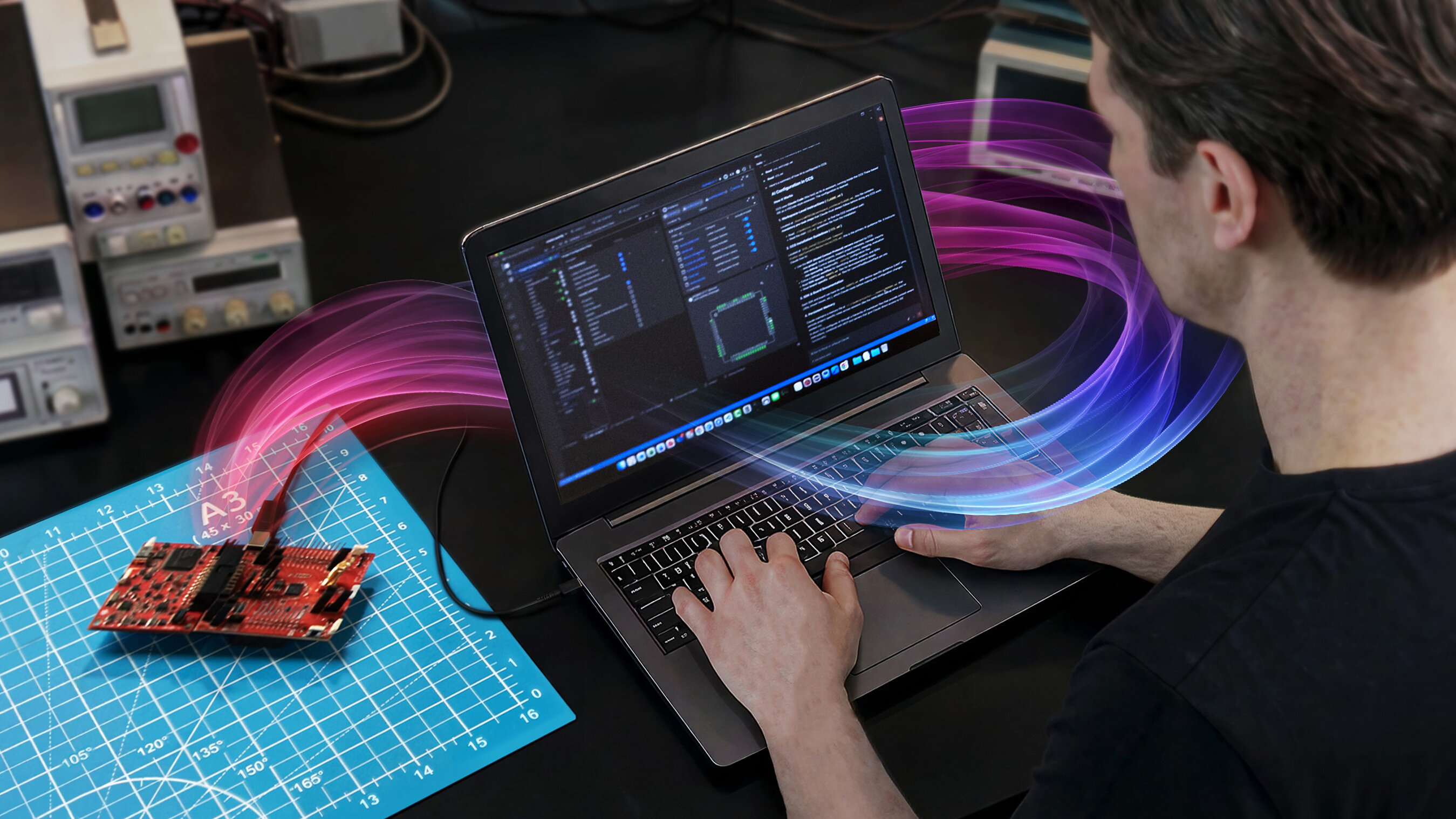
Agentic AI integration at every stage of embedded development dramatically shortens time to market, including a purpose-built skill that reduces software migration time from months to days
News highlights:
- TI is strengthening the agentic capabilities of its CCStudio ecosystem, pairing industry-standard AI agents and models with its expansive resource library to deliver highly accurate results when developing with TI MCUs, as well as wireless connectivity and radar devices.
- The industry's first agentic device migration skill reduces software migration timelines from months to days, giving engineers the flexibility to seamlessly transition between compatible MCUs without sacrificing existing software investments.
- The CCStudio development ecosystem works across developers' environments, including Visual Studio Code, bringing TI-specific context, tooling and device knowledge into different AI configurations.
DALLAS, Nov. 10, 2026 — Texas Instruments (TI) (Nasdaq: TXN) today announced significant enhancements to its CCStudio™ ecosystem, strengthening its agentic artificial intelligence (AI) capabilities in order to streamline embedded software development across microcontroller (MCU), wireless connectivity and radar applications. Moving beyond generative code assistance toward autonomous development, the CCStudio ecosystem's agentic AI framework injects device-specific knowledge directly into the AI tools engineers already use, enabling them to accelerate complex design tasks from months to days and focus on system-level design and innovation. TI is showcasing these innovations at electronica 2026, Nov. 10-13, in Munich, Germany.
For more information, see ti.com/CCStudio.
"Embedded software development is an incredibly manual and time-consuming process that has been significantly changing over the last few years with agentic AI," said Amichai Ron, senior vice president, Embedded Processing and DLP® Products at TI. "TI was one of the first semiconductor companies to enable agentic AI workflows in our development ecosystem, and over the last several months, we have been strengthening its capabilities to enable significantly better productivity. Device migration, system configuration and debugging are all integrated with agentic AI built on TI's embedded expertise. Our goal is to give developers a more efficient and accurate development experience so they can spend more time innovating."
A new era of embedded development
For the last two years, generative AI tools have been helping engineers write code faster. However, they often struggle to complete complex embedded development tasks given the lack of hardware-specific context. TI's CCStudio development ecosystem has been augmented with an agentic AI framework to address this challenge. Through context engineering, the framework injects device-specific knowledge, including software development kits (SDKs), pin configurations and peripheral data, directly into the workflow through Model Context Protocol (MCP) servers. Grounding AI models in TI data improves accuracy, reduces hallucinations and produces implementation-ready outputs. The architecture retrieves and delivers only the most relevant technical context to the model, reducing latency and token costs.
For example, TI's CCStudio integrated development environment (IDE) exposes its core capabilities to industry-standard AI agents, allowing them to generate code, configure peripherals, build the application, flash it to the device and debug it autonomously. Engineers can use simple language to move through the full development workflow in CCStudio IDE or CCStudio for VS Code, all without switching tools or rebuilding context.
To learn more, read the white paper, "Accelerating Embedded Development with Agentic AI in CCStudio™ IDE."
Accelerating time to market with the industry's first device migration skill
TI's first-of-its-kind migration skill transforms what has historically required months of manual effort into a workflow completed in days, or even hours. When a developer prompts their preferred AI tool to migrate code from a competing device to a TI device, the model invokes TI's skill to autonomously navigate the full migration process, while preserving the developer's existing software investment.
Specialized subagents each handle a distinct phase of code migration automatically: analyzing the source project, configuring peripherals, updating code and API calls, and iterating through build errors to resolution. By offloading repetitive, time-consuming aspects of migration to this specialized skill, engineers can focus on high-level innovation, including system architecture and unique application features.
Enablement across TI's embedded processing portfolio
Agentic AI capabilities in TI's CCStudio ecosystem are available today across its general-purpose and real-time MCUs, wireless connectivity devices, and radar systems-on-chip. With a modular architecture that spans task-specific skills, MCP server integrations and context injection, CCStudio tools are designed to continuously expand support for new devices, updated SDKs and emerging edge AI development workflows.
The need for these embedded processing semiconductors is continuing to grow, spurred by the proliferation of autonomous, connected and AI-enabled systems. As demand continues, the strength of TI's broad MCU portfolio and continued investment in building dependable capacity across its 300mm manufacturing footprint give customers confidence that they can scale with the portfolio they are designing in today and rely on well into the future.
TI at electronica 2026
At electronica 2026, in Hall C4, Booth No. 159, TI will demonstrate the latest enhancements in its development tools alongside innovations across its analog and embedded processing portfolios. Visitors can watch live demonstrations of agentic workflows in CCStudio IDE and CCStudio for VS Code, covering end-to-end application development from system configuration to debugging. For more information about TI at electronica 2026, see ti.com/electronica.
Availability
The CCStudio development ecosystem is available now as a free download on TI.com. The IDE supports multiple agents and models, allowing development teams to get started faster within the AI environment of their choice.
SOURCE Texas Instruments
About Texas Instruments
Texas Instruments Incorporated (Nasdaq: TXN) is a global semiconductor company that designs, manufactures and sells analog and embedded processing chips for markets such as industrial, automotive, data center, personal electronics and communications equipment. At our core, we have a passion to create a better world by making electronics more affordable through semiconductors. This passion is alive today as each generation of innovation builds upon the last to make our technology more reliable, more affordable and lower power, making it possible for semiconductors to go into electronics everywhere. Learn more at TI.com.
Trademarks
DLP is a registered trademark of Texas Instruments. CCStudio is a trademark of Texas Instruments. Visual Studio Code is a registered trademark of the Microsoft group of companies. All registered trademarks and other trademarks belong to their respective owners.